

The Forest Where I Walk Is On Fire
Does imagination help us face crisis or numb us to it?

“Climate change will manifest as a series of disasters viewed through phones with footage that gets closer and closer to where you live until you’re the one filming it.”
@PerthshireMags on X
As I write, wildfires burn in the hills of Llanwonno, above Pontypridd where I live in south Wales. The forest that I go walking in with the local Forest Church group is literally on fire right now.
Earlier this summer, my children’s school had to close because they couldn’t keep it cool enough to be safe in the extreme heat. When schools close and the smoke is hanging in the air outside my own windows, it brings the reality starkly home: we’re facing a climate emergency of our own making and we’re ill-equipped to deal with the consequences.
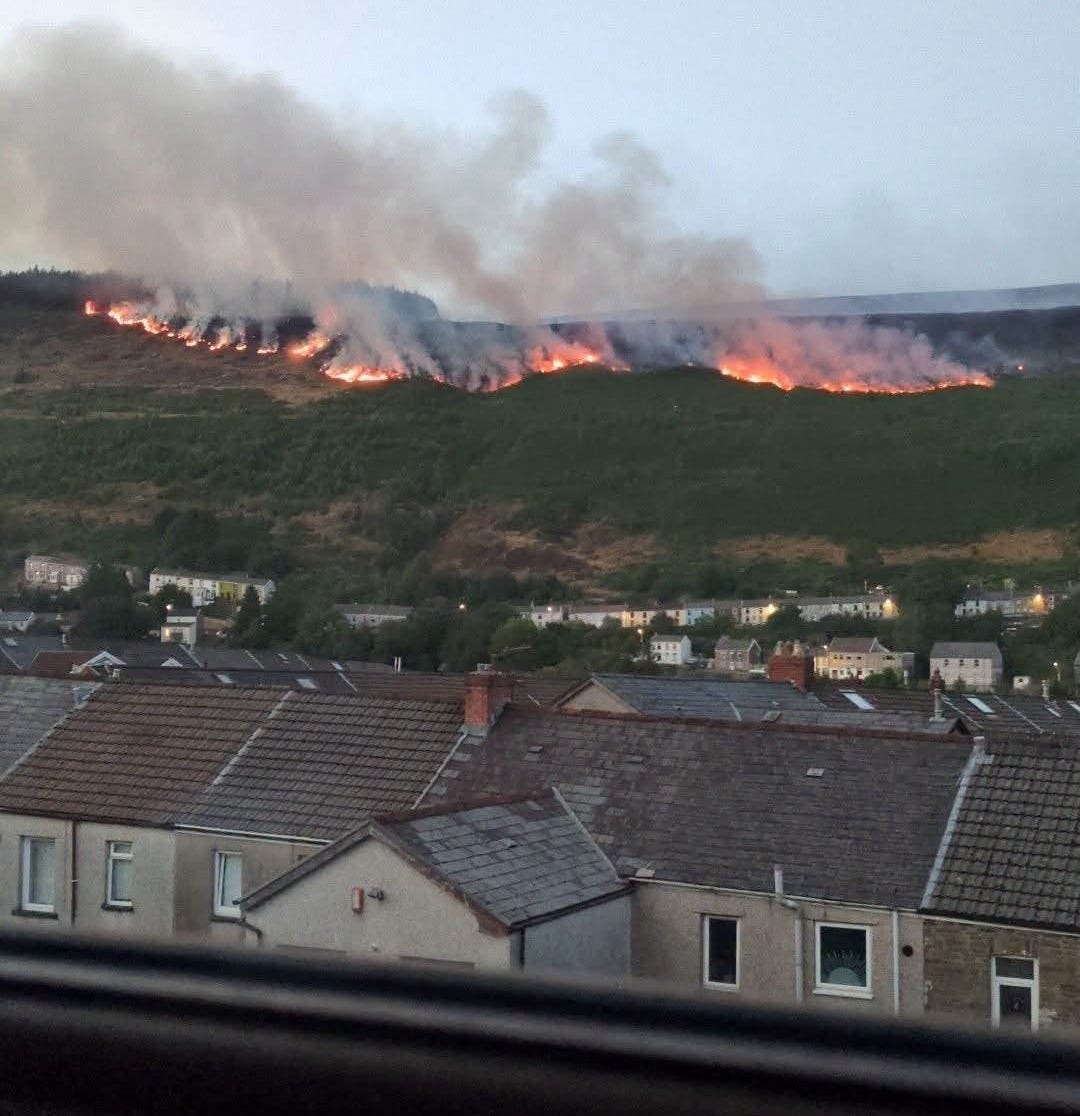
Heatwaves and wildfires aren’t new, of course. We’ve long had to deal with them from time to time. But their increasing frequency and intensity are signs in line with the broader trend. As record-breaking heatwaves are followed by record-breaking wildfires, with a record-breaking El Niño still expected to come, it seems plain to me that the climate crisis isn’t something to be imagined: it’s already here.
(Just to note, I think there’s room for debate on how we respond to this socially, economically and politically, and whether we could have reaped the benefits of industrialisation without creating these problems. But I don’t see there as being much room for serious disagreement that humans are driving climate change and that this faces us with increasing challenges in the coming years. But feel free to have at it in the comments!)
Can imagination help save the day?
As someone obsessed with story, I like to think of imagination as a positive force. Our climate challenges are the result of a series of profound failures of imagination, including:
Failure to imagine the consequences of our lifestyles, or to empathise with the impact on the people and countries who are most vulnerable to climate change
Failure to imagine change, and better ways of living more responsibly and sustainably
Failure to imagine political solutions that can mobilise broad coalitions
But I have to admit that imagination can be a double-edged sword. We can imagine and anticipate threats to avert them – or we can retreat into escapist fantasy to deny them.
We can imagine solutions and set about the hard work of building them – or we can comfort ourselves with imagined easy answers that will never fly in reality.
Do our imaginings of the future help or hinder us? Do post-apocalyptic fictions help prepare us to face the future, or numb us to it?
Facing the dystopian future
Science fiction and fantasy can provide us with images and language to speak of the challenges we face. As France recently suffered its first pyrocumulonimbus “fire storms”, which rain down wind and ash and lightning and sparks, often with rainfall evaporating before it hits the floor, it couldn’t help but occur to me that these are storms that fall like dragons, like the desolation of Smaug on Dale and the lonely mountain with conflagration and misery.
Like many, I recently watched Christopher Nolan’s The Odyssey, which impressed me as a thoughtful interpretation and engagement with Homer’s classic that connects it to present concerns. By looking to a fantastic version of the past, he speaks to our apocalyptic present: we have broken the bonds that held our civilisation together, a world is ending – and yet the film offers a hope of renewal.
The word “apocalyptic” gets thrown about loosely, as we reach for language sufficient for the scale of the challenges we face. “Apocalypse” means revelation, and what is being revealed to us is the consequences of our actions, our collective failure to stop the fire, by decades of inaction and squabbling and prevaricating.
Apocalypticism can often lend a religious fervour to climate anxiety – the sense that we are being punished for our environmental transgressions. That doesn’t necessarily work in favour of the climate cause: people are wary of fanaticism and to having sacrifices demanded of them, as we see in climate scepticism and the backlash to “net zero” policies. But there is a form of apocalyptic storytelling that doesn’t just reveal our failings, but points beyond them to solutions.
Imagination as threat-anticipation
Imagination is important for anticipating and escaping disaster. Part of its survival value is that imagination allows us to picture possible threats and devise plans and strategies to escape it.
When the COVID pandemic hit and lockdown was imposed in 2020, some people I spoke to said things like “I can’t believe this is actually happening!” I found this surprising: I’d read enough both science fiction and popular science to know it was only a matter of time before we faced some kind of pandemic. I’d absorbed plenty of post-apocalyptic stories, such as Station Eleven by Emily St John Mandel and the Rise/Dawn/War of the Planet of the Apes movie trilogy.
So on some level I was imaginatively prepared and perhaps had a more realistic assessment of how long it would take to get through the pandemic – especially in the face of misleading suggestions from politicians that it would only take a few weeks to bring it under control. On the other hand, I couldn’t fully imagine quite how difficult that time would be: I got Covid early on, and ended up with Long Covid, burnout and a whole cascade of long-term impacts on me and my family. Millions lost loved ones.
But compared to the post-apocalyptic scenarios I’d absorbed imaginatively, at least Covid didn’t turn out to be civilisation-ending, or result in widespread social collapse (as much as it did fray social cohesion and trust). The pandemic didn’t turn out to be Stephen King’s The Stand, where a lab leak wipes out 99.4% of the population, leaving the survivors to battle between good and evil in the ruins of society.
So without minimising the pandemic’s impact, I’m grateful it wasn’t worse, because I can easily imagine it being otherwise.
Imagination as solution-finding
From Deep Impact and saving the world from an asteroid, to Project Hail Mary and rescuing Earth from a sun dimmed by alien astrophage, science fiction frequently offers us apocalyptic visions along with salvation from disaster.
Nolan tells us such a tale in Interstellar. In it, a blight on Earth’s crops has pushed humanity to the edge of extinction, and despair about the future. While not explicitly linked to climate change, the resonance with our climate anxieties is obvious. But the film shows us a humanity that has given up on looking upwards, on reaching for the stars. Interstellar warns us of the danger of ceasing to imagine a better future.
Imagination enables us to picture ways in which the world might be made better, in which our problems might be solved. Imagination is part of the process of understanding something, of putting together clues, following a hunch until you reach that Eureka! moment of insight and invention.
This can often be an uncomfortable and subversive process, and one that existing powers and authorities can view very dimly. Ursula K Le Guin wrote an essay It Doesn’t Have to Be the Way It Is about the power of imagination to see how the world could be different:
“Why are things as they are? Must they be as they are? What might they be like if they were otherwise?” To ask these questions is to admit the contingency of reality, or at least to allow that our perception of reality may be incomplete, our interpretation of it arbitrary or mistaken.
Imagination has the power to question reality as it is presented to us, and imagine alternatives.
Imagination and wishful thinking
There is also a dangerous flip-side to imagination, which is wishful thinking.
We imagine that something will turn up. We imagine some technological breakthrough will be made that will take all our problems away, without doing the hard work of testing and building it.
We imagine the pain of the climate crisis will be felt by those people over there in some distant part of the world, rather by us in comfortable developed Western countries.
Interstellar offers hope in the stars: the dream that humans will spread out into the cosmos. Matthew McConaughey says “Mankind was born on Earth. It was never meant to die here.”
Now I love the idea of humans boldly going where no one has gone before. I thrill to science fiction that tells stories of exploration and expansion. But scientifically speaking, I am unpersuaded that interstellar space travel is anything but delightful fantasy. The hard physical constraints on human life mean our destiny is bound up with our home planet.
As I wrote in an article on Interstellar back when it was released:
Interstellar travel is the rapture for materialists. As George Monbiot astutely observed in the Guardian, it’s the hope that rather than dealing with the problems we face here on earth, we can escape to a new world. But even if that were possible, it doesn’t deal with human nature, and so we would just take all our problems with us.
We need imagination coupled with empiricism; ingenuity that is connected to fact and to practical reality.
When hope turns dangerous
Hope can be a trap, if it is just wishful thinking that a solution will present itself. Hope doesn’t help unless there is something real to base our hope on.
Politics is often plagued by Cakeism (we can have our cake and eat it, avoiding hard trade offs – like politicians abandoning Net Zero commitments while assuring us the climate will all somehow work out fine) and Boosterism (we just need to Believe in Ourselves and we will overcome all difficulties – see Brad Bird’s sci-fi paean to techno-optimism Tomorrowland for a pop culture example, or former British PM Boris Johnson’s speeches about British ingenuity for the political equivalent).
The confidence to attempt to find solutions is necessary but it is far from sufficient.
A hopeful disposition is helpful if it motivates us to action, but false hope risks sending us up blind alleys or lulling us into complacency. We won’t solve our problems if we despair, but we need to face the problems before us with clear-eyed realism if we are to have any chance of finding solutions that actually work.
Now I don’t want to foreclose imagination or scientific investigation. If the warp drive or equivalent is possible, I’d be delighted. But we mustn’t allow the hope of some paradigm-busting breakthrough to stop us from taking more immediate action to address our problems in the here and now.
In Interstellar, Michael Caine’s character Dr Brand, claims: “We’re not meant to save the world. We’re meant to leave it.”
That’s exactly the kind of world-denying escapism we need to avoid. Astronaut Cooper similarly bristles at the idea of humans becoming caretakers rather than explorers – but if we are to be explorers, we need to first take care of our beautiful, unique home of planet Earth.
In Interstellar, there is a higher power manipulating events to save the world – but it isn’t God, but future humanity, bootstrapping its survival in a temporal paradox. Cooper plays his part in closing the self-causing temporal loop that will take humanity forward into the stars. Nolan’s narrative seeks to stir up our imaginations to discovery and exploration again, rather than despair. That’s a message worth heeding, even as I would caution that we should focus our imaginative energies on a better future here on this world first, rather than out there in the stars. I also believe it underestimates the depth of our problem and need for change.
Imagination and transformation
Living sustainably on our planet is a deeper issue than merely technical problem-solving. There are deep moral and spiritual dimensions to it.
One dimension is the need to accept limits. This goes back to the Cakeism problem: we refuse to accept that there are limits and trade-offs. Now some of these can be mitigated by technology and innovation given time. But unless we are ready to ask “what is enough?”, to embrace contentment, we’ll keep running up hard against reality by living beyond our means ecologically.
Again, the tension is that we often don’t know in advance which limits are genuinely fixed, and which can be overcome through new knowledge and technology. The famous Serenity Prayer asks for:
the serenity to accept the things I cannot change, the courage to change the things I can, and the wisdom to know the difference.
That’s become familiar to the point of cliché but speaks to a genuine tension that we all face.
Another dimension is the need for grace. One of the paralysing psychological dynamics of the climate crisis can be the sense of guilt and shame that comes with recognising our culpability for messing up the planet. It can make facing the problem too much to bear, because it means facing our own failings as a species square in the eye.
In the Christian understanding, grace is the scandalous, unmerited forgiveness that God offers to all who truly repent and believe. The scandal comes with the possibility that people might abuse it, and use it as license to continue their behaviour – “cheap grace”, as German theologian Dietrich Bonhoeffer put it. But the Christian understanding is that grace, when truly understood, is liberating and transformative. Grace enables us to move past our sin and to begin the process of change.
A third dimension is our relationship to nature. Unless we can transform our vision of the world from a bare thing to be used and dominated, to an inherently meaningful and valuable order that we are part of, and bear responsibility for and to, the cycles of our broken relationship will just repeat.
This is one of the reasons the re-enchantment (or de-disenchantment!) project of writers like Malcolm Guite in his Merlin’s Isle series (watch my interview with him here) and Martin Shaw in Liturgies of the Wild (read my review here) is so important: we need to recover a view of creation as a gift, spiritually alive, which we are not separate from but participate in.
Paul Kingsnorth’s Against the Machine is also helpful in stirring our imagination to consider the alternatives to what Kingsnorth dubs “the Machine” of technocratic modernity. I would see more of a positive role for technology and civilisation than Kingsnorth, but his jeremiad is a powerful counterblast to the prevailing ideology of progress that pervades our age.
The climate crisis and the Creator
Underlying that sense of creation as gift is a gratitude towards the Creator as giver. Of course, you don’t need to believe in God in order to pursue a transformation of our relationship with our planet – many people are pursuing that from all sorts of worldviews and perspectives.
But as a Christian myself, I believe it helps to recognise not only a responsibility to the natural world, to our neighbours and to future generations, but also to the Creator who made it all good. If you want to save the planet, start by attending to your soul. Contentment comes from finding alignment with the divine, with the transcendent – and so does motivation to change, to what in Biblical terms might be termed “repentance”.
If you want to save the planet, start by attending to your soul.
Modern people often baulk at the language of “sin”, but I think many of us recognise in our treatment of the planet that we have fallen short, we have transgressed boundaries we should have respected, we have left undone things that we should have done to address the problem. It’s perhaps here that the secular imagination comes closest to really feeling the weight of what past generations called sin.
But what a secular framework struggles to provide is an equivalent expression of the idea of grace, of forgiveness. Christians believe that forgiveness is a gift of God, who gives us every chance to make amends and turn back to him. Far from encouraging indifference or self-indulgence, Christians see grace as doing something guilt simply can’t: it moves us to lasting change, born of gratitude and generosity.
Again, there is much that needs to be done practically to address our problems on top of this, but I believe this spiritual dimension is the foundation of true change of human nature away from self-absorbed short-sightedness, to loving sacrifice for the sake of our neighbours, natural world and our future.
Within the Christian tradition, the tension of the “now and not yet” of the kingdom of heaven helps guard a hopeful realism. The doctrine of sin guards against a naive utopianism, of thinking we can build heaven on earth merely by technical prowess – an attempt which can easily turn dystopian. But because Christians have the hope that Jesus is coming back – not, as is commonly misunderstood, to whisk us away to heaven elsewhere, but instead to renew the world (read more on Heaven vs Resurrection) – we can participate in the project of the kingdom of heaven, and work towards its imperfect, partial realisation in the present. Imagining the kingdom coming allows us to renew the world through building the kingdom now.
And with recognising the “now and not yet” comes hope: A hope of redemption that isn’t complacency, but the recognition that help is on offer to humanity, in all our weakness, cruelty and short-sightedness, if only we have the humility to accept it.
Can imagination help save the day?
Can this help on the slopes of Llanwonno, as firefighters try to stop the flames reaching the nearby villages and towns of the Valleys?
Probably not right now, in the heat of the moment. But stories can prepare us to come together in solidarity to deal with crises that face us, and imagine better worlds, even as those disasters on social media get closer and closer.
The best science fiction stories do something similar to the Christian story, mapping the tensions between the imaginable and the possible, the utopian and the achievable, the now and not yet.
Imagination is a necessary ingredient in finding better futures and in finding empathy to care for one another in the face of increasing climate challenges.
But imagination alone isn’t enough.
Imagination can put us on the path to truth and to solutions, if we test what we grasp imaginatively rationally and empirically.
Imagination and reason need to work together – they make us aware both of possibilities and our limits.
And our limits point us to our need for help: help from one another in communities of care and resilience, and, I would submit, help from our Creator.
Let our imaginations burn brighter than the fires we have unleashed – not with fire of apocalyptic destruction, but of revelation and renewal.